Bluebell Walks in the Wye Valley: Where to Go and When
Rebecca Cunningham

Loading content...
Rebecca Cunningham
In April and May, bluebells spread beneath the trees of the Wye Valley, with fresh leaves overhead and the scent of wild garlic in some woods. Whitestone, the Kymin, Prisk Wood and Wyndcliff each offer a different way to enjoy the season, from woodland paths among mossy rocks to viewpoints high above the river.
You can make time for a local circuit or enjoy the flowers as part of a longer walking holiday. Use the comparison below to choose a walk, with starting points and terrain details in each section.
Mid-April to mid-May is a useful starting point when planning a Wye Valley bluebell walk. The display shifts each year, so treat those weeks as a guide rather than a promise.
A mild spring can bring flowering forward; a colder start can delay it. If bluebells are the main reason for your trip, check recent local photographs and reports close to your travel dates to see how the display is developing.
These are separate walks, rather than one connected route. Distances are approximate and refer to the routes described below.
| Walk | Distance | What to expect |
|---|---|---|
| Whitestone, above Llandogo | 1.2 miles / 2 km | Mostly level circuit; a stony section |
| The Kymin, near Monmouth | 1 mile / 1.6 km | Short circuit with a steep descent and an uphill return |
| Prisk Wood and Penallt | 3 miles / 4.8 km | Woodland, lanes and fields; steep steps and climbs |
| Wyndcliff circuit from Lower car park | 1.2 miles / 1.9 km | Strenuous; the steep, uneven 365 Steps, with a shorter approach available |
At Whitestone, look for bluebells in the deciduous woodland above Llandogo. The Wonders of Whitestone circuit combines a return through mixed woods with three viewpoints over the Wye, so you can pause among the flowers and then look out across the valley. It is a useful choice for a shorter spring outing with places to sit.
“Since settling to live in the Wye Valley, I would say Whitestone is my favourite. Walking through the bluebells brings back memories of woodland walks with my Nan back in Pembrokeshire when I was little. Our daughter, Hope, loves it there too. And, whenever my mother in law Judy, visits, we will always walk in the Wye Valley, as she misses the wonderful walks we have on our doorstep!”
Carys, Celtic Trails
Start at Whitestone car park and follow the waymarked Wonders of Whitestone circuit. Natural Resources Wales grades it easy: most of the route is level, with one stony section. Benches at the viewpoints give you somewhere to pause.
For a longer outing, the Duchess Ride Viewpoint Trail covers 3.1 miles (5 km) there and back, following part of the Wye Valley Walk. That distance is the whole outing, not an extra loop to add to the shorter circuit.
Parking is free. Use the Natural Resources Wales directions and trail information; the local postcode covers a wide area and will not take you directly to the entrance.
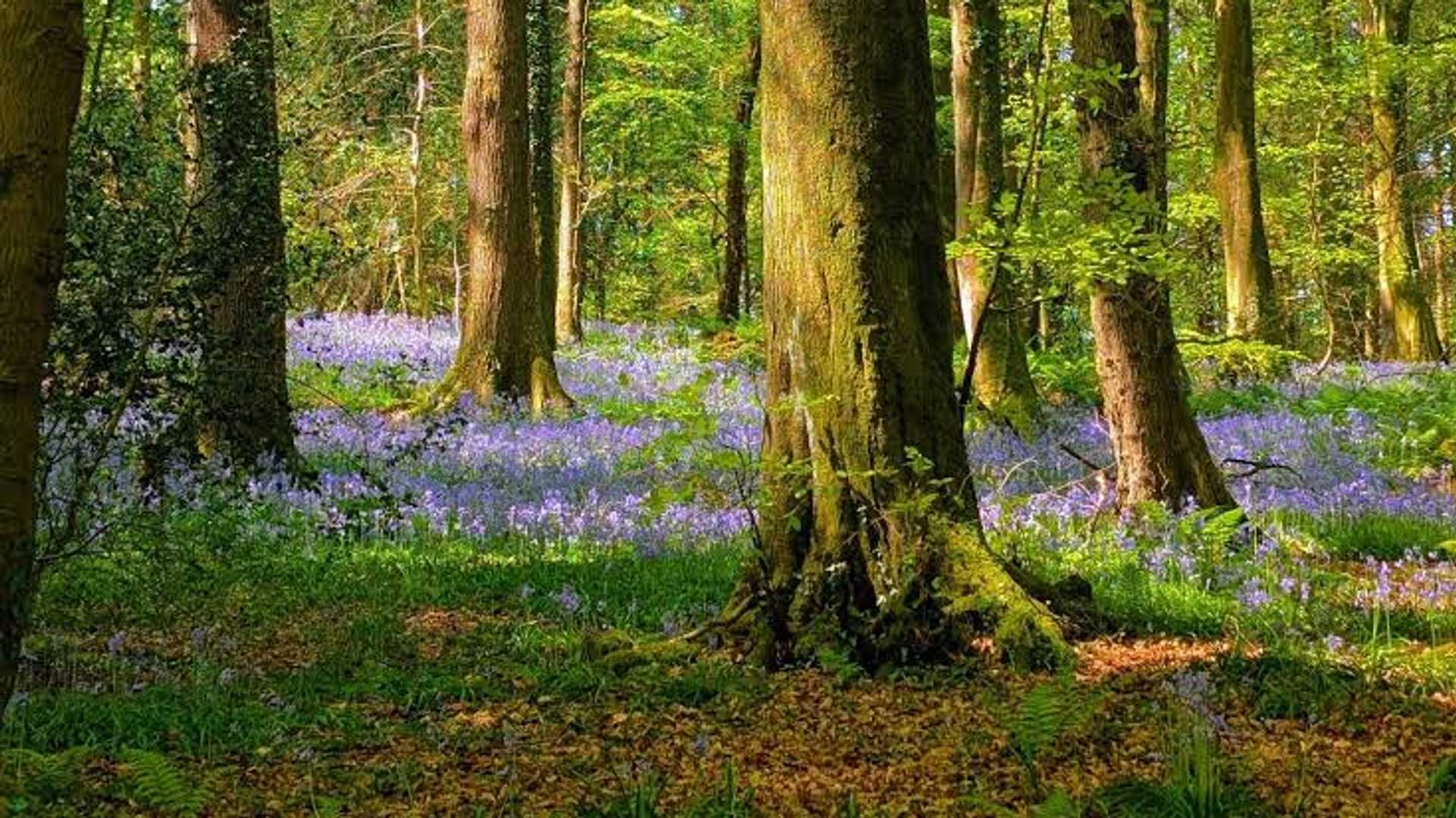
At the Kymin, look for bluebells among the trees on the hill and in Beaulieu Grove, the woodland beyond the Round House. The Woodland Trust records bluebells in the grove’s mature beech woodland. Moss-covered boulders and twisted birch and beech trees give the walk a different character from the open views over Monmouth.
Start at the National Trust car park and follow the Discover the Kymin walk, passing the Naval Temple and Round House before entering Beaulieu Grove. The route descends through woodland and returns uphill across fields.
Expect grass paths, mud after rain and kissing gates. The National Trust grades the route moderate and says the kissing gates make the full circuit unsuitable for wheelchairs and pushchairs. Allow time for the descent, which can be slippery.
The approach road is steep and winding, and there are no toilets on site. Check the Kymin visitor information and take the National Trust route directions with you. The grounds are open to visitors; the Round House is now holiday accommodation.
In Prisk Wood, bluebells share the spring woodland floor with wild garlic and dog-violets. Ferns and moss cover boulders and fallen timber around the streams, while old millstones remain among the quarry workings. Choose this walk for the flowers and the details close to the path, with time to stop and look.
For a longer outing, follow the Puddingstone and pubs circular walk. The official leaflet starts beside the Boat Inn at Lower Penallt, reached on foot across the old railway bridge from parking in Redbrook. The route links the river, Prisk Wood and the fields around Pentwyn Farm.
This is a hilly walk with lanes, uneven paths and steep steps. Inside the reserve, rough paths and sleeper bridges cross ground altered by quarrying. Allow time for the climbs and rough ground.
Reserve-side parking is extremely limited, so use the Redbrook start. Carry the official route leaflet and check current bridge information before travelling. If you plan to stop for lunch, check the Boat Inn’s food service times.
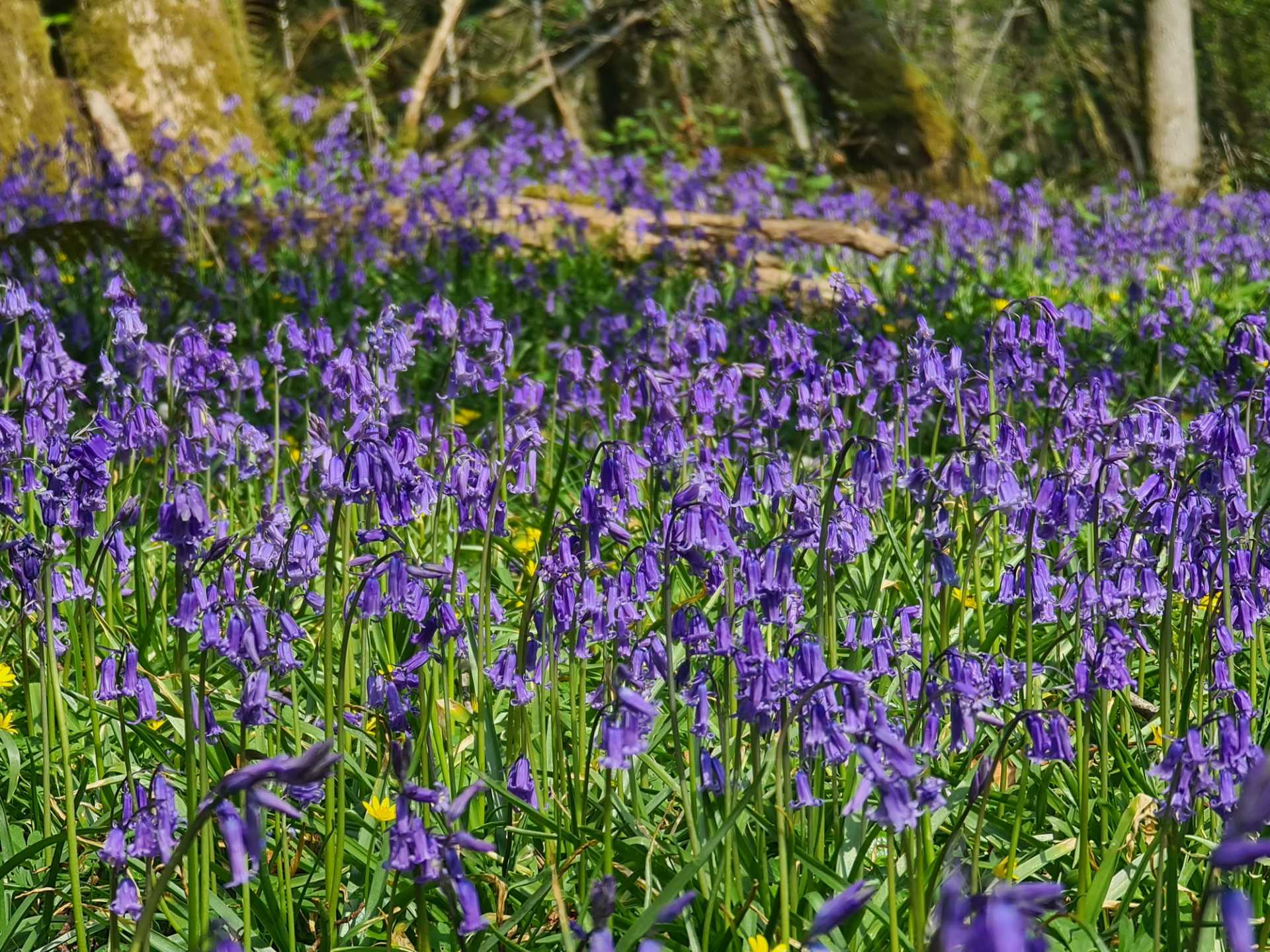
Around Eagle’s Nest, the woodland along the Wye Valley Walk is a place to look for spring bluebells. The local trail through Wyndcliff passes beech trees and large yews before reaching the viewpoint over a bend in the Wye towards the Severn estuary. Choose it for woodland flowers with a view to finish, either on the full circuit or the shorter approach from Upper Wyndcliff.
“I agree with Carys, Whitestone is great, but my personal favourite, especially when the bluebells are out, is Wyndcliffe. On a sunny day, I love the dappled light through the trees, and then you reach Eagle’s Nest and the view opens out over the Wye.”
Ben, Celtic Trails
The full circuit starts at Lower Wyndcliff car park, across the road from the trail entrance. It includes the 365 Steps, with very steep, uneven ground and drops beside parts of the path. Natural Resources Wales grades this route strenuous. Walking clockwise means descending the steps; going anti-clockwise means climbing them.
To avoid the 365 Steps, start at Upper Wyndcliff car park and walk directly to the viewpoint, returning the same way. Visit Monmouthshire gives directions to both car parks. There are still steep steps down to the viewpoint itself, so this approach is not step-free. The table’s distance applies to the full circuit from Lower Wyndcliff.
Parking is free. Check the current Wyndcliff trail information before setting out, particularly after wet weather.
Download the route directions and check for closures before leaving. Wear footwear with a good grip, take water and a waterproof, and plan food and toilet stops. If you are travelling without a car, check the connection to the actual starting point and your return journey.
Enjoy the flowers from established paths, including when taking photographs: trampling damages bluebell leaves. Keep dogs on the path, follow local lead requirements and leave the flowers where they are.
For several days on foot, our Wye Valley Walk holidays follow the river through changing country. The long-distance trail passes through both Whitestone and Wyndcliff Wood, bringing spring woodland into the journey itself. Choose an itinerary that includes these lower-valley sections if bluebells are a particular interest.
Gilpin’s Wye Tour runs from Ross-on-Wye to Chepstow. On the six-night itinerary, the Ross-on-Wye to Kerne Bridge day crosses Chase Hill and the wooded country around Leys and Howle Hill, where the route description highlights bluebells. Its final Tintern to Chepstow day also passes the Eagle’s Nest viewpoint.
The full local circuits described above are separate day outings; the holiday routes pass through these woods without following each complete circuit.
If your spring plans are still open, our spring walks collection covers other destinations to consider.
Your Celtic Trails holiday includes accommodation, your walk pack and any required transfers between your accommodation and the trail. Your main bag moves ahead to the next stop, so you walk the day with only what you choose to carry. You receive a free, no-obligation personalised estimate before deciding whether to book.