Haunted Walking Trails: Folklore & History
Carys
Loading content...
Carys
Some of the British Isles' most intriguing walking trails pass through places steeped in history, folklore and mysterious legends. Whitby Abbey on the Cleveland Way helped inspire Bram Stoker's Dracula. On the Isle of Man, Peel Castle is said to be haunted by a mysterious black dog. And in the Scottish Borders, Melrose Abbey is believed to be the resting place of Robert the Bruce's heart.
These stories have endured for centuries, becoming part of the character of the places themselves. We've chosen three walking trails where history, folklore and legend add an extra dimension to exploring the landscape on foot.
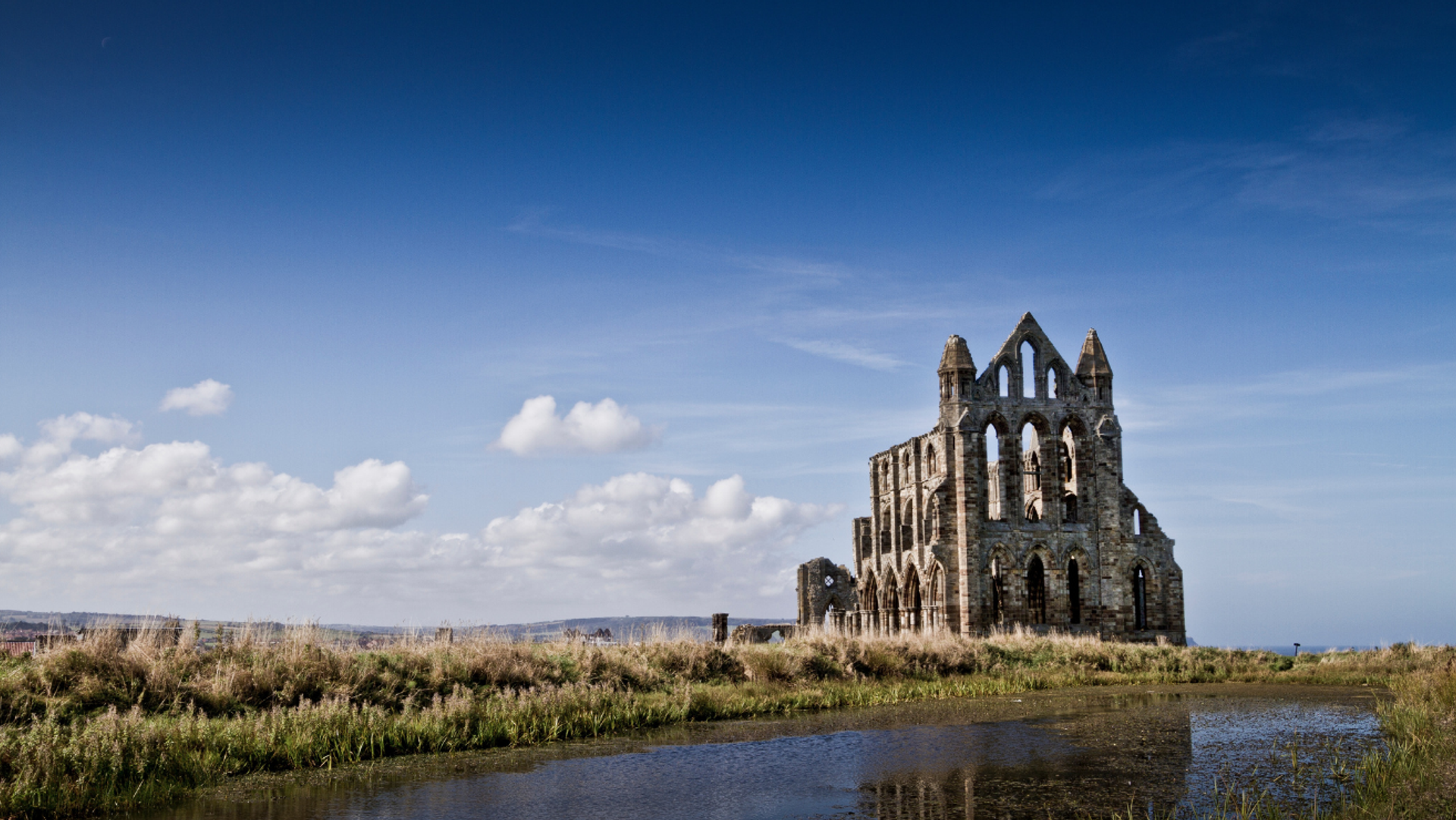
High above Whitby harbour, the ruined arches of Whitby Abbey stand exposed to the North Sea winds. They've watched over the town for centuries, but their association with Bram Stoker's Dracula has given them an altogether different place in history.
When Stoker visited Whitby in the late nineteenth century, he was already working on a vampire novel. During his stay, he explored the town, its harbour and the churchyard of St Mary's, which stands close to the abbey ruins on East Cliff.
At Whitby's public library, he came across the name Dracula while researching the history of Wallachia and Moldavia. He also heard the story of the Dmitry, a Russian ship that had run aground on the beach below the cliffs.
Both discoveries found their way into his novel.
In Dracula, the ship Demeter arrives at Whitby after a terrible voyage. Its crew has disappeared, and the captain is found dead at the wheel. A large black dog leaps ashore and races up the steps towards the churchyard.
The harbour, the old gravestones and the abbey above the town became part of Stoker's fictional Whitby. Yet these were real places he had explored during his visit, and much of their character remains recognisable today.
You can read more about how the town influenced the novel in English Heritage's account of Dracula and Whitby.
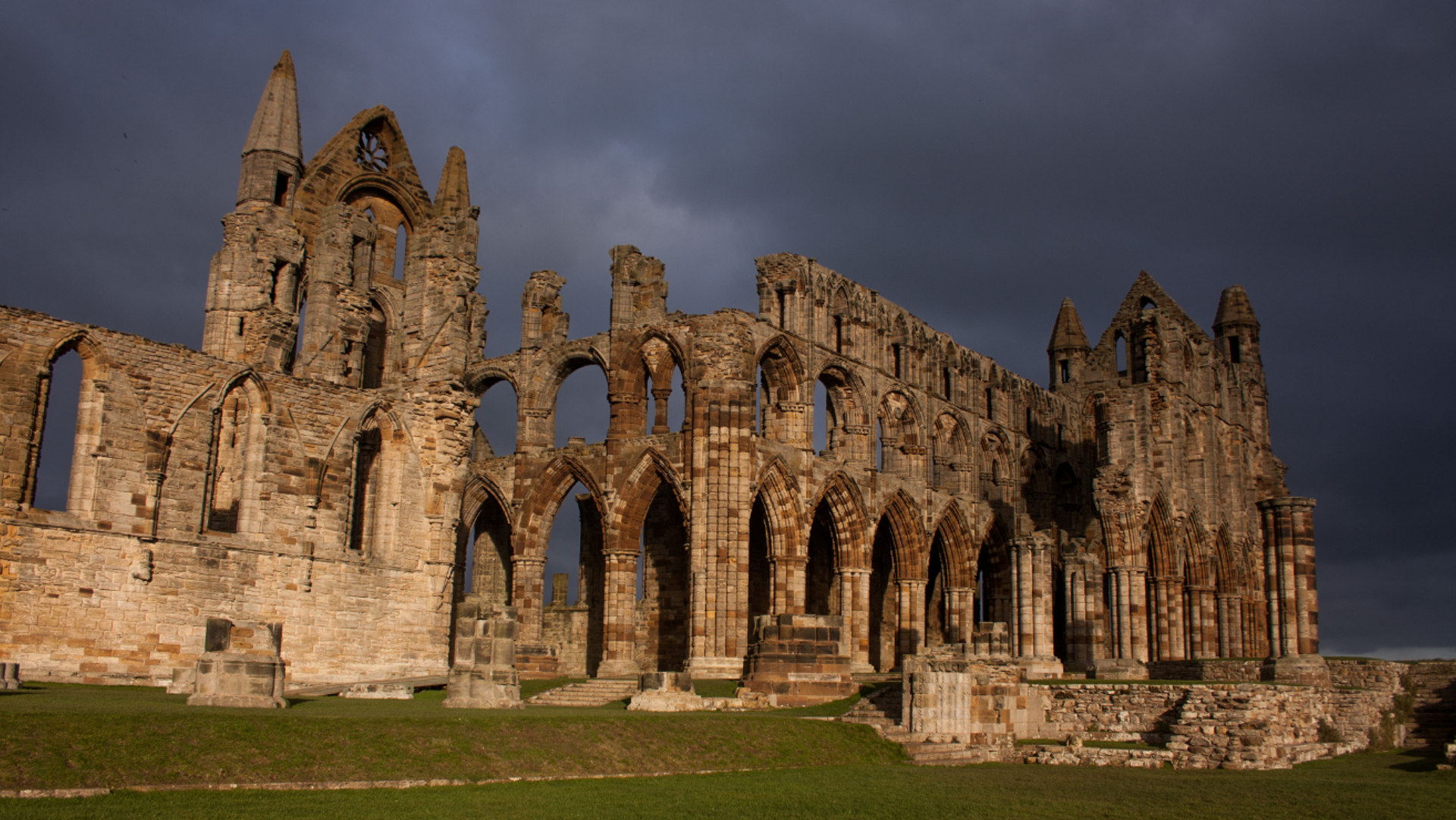
The Cleveland Way takes you through the North York Moors before turning south along the Yorkshire coast, passing fishing villages and following clifftop paths above the North Sea.
Whitby comes during the coastal section of the walk, offering a marked contrast to the open moorland of the earlier stages.
If you're staying overnight, there's time to explore the old town and climb the steep flight of steps to St Mary's Church and the abbey. The churchyard looks out over the harbour, while the medieval ruins stand a little further along the headland.
There's much more to Whitby's history than its literary connections. The headland was the site of an important Anglo-Saxon monastery, and the later Benedictine abbey played a significant part in the town's religious life.
The coastal walking beyond Whitby can be demanding, with repeated climbs and descents as the path follows the cliffs towards Robin Hood's Bay. It's an exposed stretch in poor weather, but one that rewards you with far-reaching views along the Yorkshire coast.
After spending time among Whitby's narrow streets and old buildings, it's easy to see why Stoker remembered the town.
The Isle of Man has a strong tradition of folklore, with stories of fairies, mysterious creatures and unexplained happenings associated with places across the island.
One of its best-known legends belongs to Peel Castle.
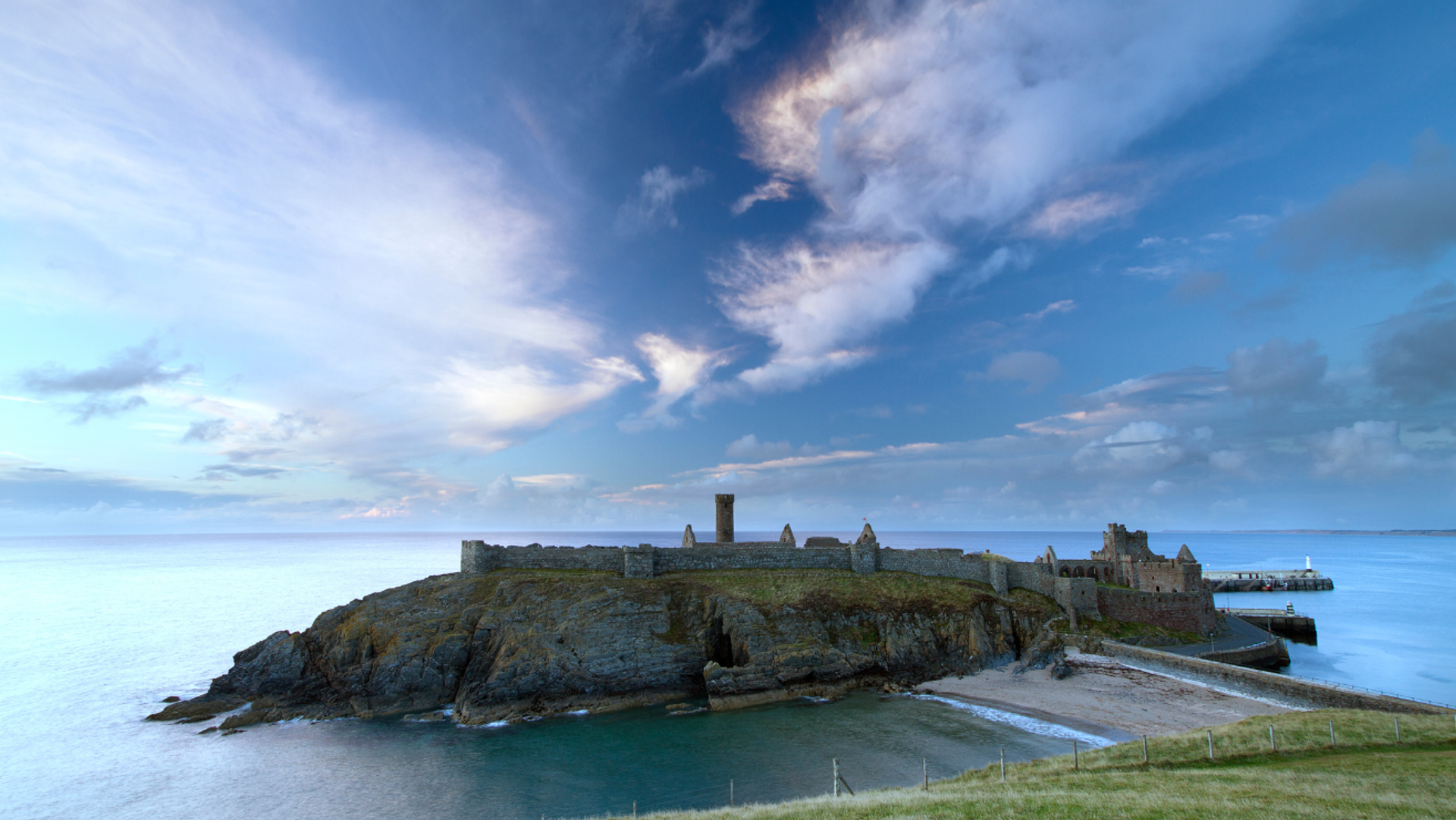
Standing on St Patrick's Isle, connected to the harbour town of Peel by a causeway, the castle has been occupied by Vikings, religious communities and soldiers over the centuries. Its surviving walls enclose the remains of churches, a medieval cathedral and other buildings.
According to local folklore, it was also home to the Moddey Dhoo, a mysterious black dog.
The story was recorded by George Waldron in the eighteenth century. He described a large, shaggy black spaniel that appeared in the castle's guardroom, where it would settle beside the fire.
The soldiers gradually became accustomed to its presence, although nobody was willing to be left alone with it. They believed the creature was an evil spirit and even avoided swearing when it appeared.
Then, according to the legend, one soldier decided to dismiss his companions' fears. He ventured alone through a passage associated with the animal and returned in such a state of terror that he could not explain what had happened.
He died shortly afterwards.
The dog was never seen again.
Whether the story began with an unusual animal, an old superstition or something else entirely is impossible to know. But the Moddey Dhoo remains part of the island's folklore, and Manx National Heritage still includes the legend in its account of Peel Castle.
The Isle of Man also celebrates Hop tu Naa, its traditional autumn festival, which takes place on the same date as Halloween.
Associated with the end of the harvest and the beginning of winter, Hop tu Naa has its own songs, stories and customs.
Instead of pumpkins, Manx families traditionally carved lanterns from turnips, known locally as moots. Children carried these lanterns while singing traditional songs, a custom that continues today.
The island's folklore is particularly closely connected to its culture, and Hop tu Naa traditions remain an important part of Manx life.
The Isle of Man Coastal Path, known locally as the Raad ny Foillan or Way of the Gull, follows the island's varied coastline through fishing towns, sandy bays and rugged headlands.
Approaching Peel from the south, the path passes through Glen Maye before returning to the open coast. Undulating clifftop paths lead towards Peel Hill, with views of the castle, harbour and St Patrick's Isle appearing as you draw closer to the town.
The castle is well worth exploring while you're here. Its ruined buildings offer a glimpse of the island's Viking and medieval past, while the grounds look out across the Irish Sea.
Walking around the island varies considerably. Some stretches follow gentle shoreline paths, while others involve steep climbs, exposed headlands and rougher ground. It's worth choosing an itinerary that suits your preferred daily distances.
The Moddey Dhoo may be the best-known ghostly resident of Peel Castle, but the island has plenty of other stories to discover as you walk.
Among the rose-coloured ruins of Melrose Abbey lies one of Scotland's more unusual royal burial stories.
Robert the Bruce, King of Scots, wished for his heart to be carried on crusade after his death. His body was buried at Dunfermline Abbey, while his heart was entrusted to his loyal companion, Sir James Douglas.
Douglas carried it south, intending to fulfil the king's wishes, but was killed in battle in Spain.
The heart was recovered and eventually returned to Scotland, where it was buried at Melrose Abbey, a place with which Bruce had close ties.
For centuries, its precise resting place remained uncertain.
During excavations at Melrose, archaeologists discovered a small casket believed to contain the king's heart. It was first found in the early twentieth century and rediscovered during further archaeological work decades later.
Inside was what appeared to be a preserved human heart.
However, researchers could not conclusively establish that it belonged to Robert the Bruce. Other heart burials were recorded at Melrose, and the remains could not be reliably identified.
The casket was eventually reburied, and a memorial now marks its believed resting place.
The full account of the discoveries is recorded by Historic Environment Scotland.
It's an unusual story, made more compelling by the uncertainty that remains. A king whose name is so closely associated with Scotland's independence had his heart carried far from home, only for it to return to a quiet Borders abbey.
Melrose itself has a turbulent past. Its position close to England left it vulnerable to repeated attacks, and much of the abbey church was rebuilt following destruction during the medieval wars.
The remains still give a remarkable impression of the building's former scale.
The Borders Abbeys Way connects the historic abbey towns of Melrose, Dryburgh, Jedburgh and Kelso.
Following riverside paths, farmland, woodland and stretches of open country, the route traces a region shaped by centuries of religious life and conflict.
Melrose Abbey stands close to the walking route through the town, with the Eildon Hills rising above the surrounding countryside. It's worth allowing time to explore the ruins rather than simply passing through.
Elsewhere, you'll follow sections of the River Tweed and encounter quieter countryside between the abbey towns. Much of the walking is relatively gentle, although some stages include longer climbs, uneven paths and stretches of minor road.
The abbeys are impressive places in their own right, but knowing something of their history changes the experience of visiting them.
The Borders have long been a place where loyalties shifted, armies crossed and communities rebuilt. The ruined abbeys offer some of the clearest traces of that past.
You don't need to believe in ghosts to appreciate the stories attached to these places.
Whitby's literary connections, the Isle of Man's folklore and the history of Melrose Abbey all offer different ways of understanding the places you pass through.
And that's part of the pleasure of a long-distance walk. There's time to stop at an old churchyard, follow a narrow street down to the harbour or spend an afternoon exploring ruins that have stood for centuries.
Sometimes these places are a reason for choosing a particular route. Sometimes you come across them almost unexpectedly, and they become what you remember most.
If one of these trails has caught your interest, Celtic Trails can help you plan a self-guided walking holiday, with accommodation in local inns, guesthouses and B&Bs, breakfast each morning and luggage transfers arranged.
Your main bag moves ahead to the next stop, so you walk the day with only what you choose to carry.
You'll receive a personalised estimate first, with no obligation to book.